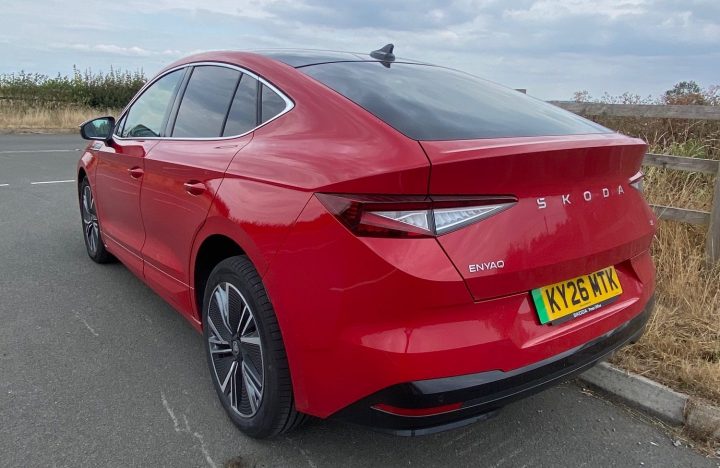
Skoda has traditionally been a conservative car-maker but it’s undergone a transformation this decade as it responded to changing buying habits and the arrival of electrified cars, notably from the Far East.
Initially it was a little slow responding to the new challenges but as part of the Volkswagen Audi Group it quickly developed some very good cars to offer buyers who loved the brand.
 The all-electric Skoda Enyaq SUV was unveiled in 2020 and the Coupe two years later as a more stylish family five-seater alternative. There’s a little difference in their luggage space with the SUV taking up to 1710 litres maximum.
The Skoda Enyaq is available in the Coupe style we tested or the boxier SUV shape, which has more versions in its stable, SE L, Edition, SportLine and vRS which differ in powertrain and trim.
Coupe shapes come in Edition, SportLine and vRS only. Prices for the two series span from £39,520 to £54,400. Buyers should remember that once the final on-road price passes £50K they have to pay a premium on road tax for five years from second registration, so carefully pick your model and accessory packs which you are possibly tempted to add on.
 For the latest Enyaqs this year, Skoda has significantly improved the out of sight technology behind the switches and touchscreen.
Enyaq models feature a modernised Android-based infotainment system for the first time, bringing a new look and feel, a redesigned home screen, grid layout, favourites and search function as well as enhanced personalisation options for an improved, more intuitive experience.
The next-generation infotainment concept forms part of an upgraded on-board platform introduced with the latest production run, making these advancements exclusive to newly produced vehicles.
 A new in-car app store will make additional applications available directly via the infotainment system, including both Škoda apps and selected third-party apps such as Spotify and YouTube, along with a number of apps from categories such as audio and video streaming, casual gaming, news, weather and more.
For the first time, Škoda vehicles will also feature a digital key. Once the phone has been paired with the vehicle and set up in the MyŠkoda app, users can lock, unlock, and start the vehicle with their smartphone.
When initialised within the Škoda app they can share access, for example, with family members via the smartphone’s built-in wallet app.
Škoda’s own charging service Powerpass is now integrated directly into navigation, showing charging-station ratings, prices and enabling charging authorisation straight from the navigation screen.
 Search filters include 20 selected providers, charging power, or availability. Users can also create lists of preferred charging point operators, or CPOs they want to avoid. The car came with dual fast and slow charging cables, which really is very sensible.
As of now, 1,000,000 public charging points across 28 European countries are accessible via Powerpass. The vehicle’s maps now also offer Google Online Search, Satellite Maps and an overview of points of interest along the route. Furthermore, Plug&Charge will also enable authorisation with compatible home wall boxes.
Possibly of greater importance for users are changes to the clever powertrain’s four options – eco, normal, sport and individual – which now give two intensities of energy recovery and effectively make the car a single pedal drive if desired to maximise economy while maintaining a softer application if wanted.
The Enyaq Coupe packed a punch from its motor and rear wheel drive transmission with good, useful acceleration to keep up with traffic flow and safely overtake if needed.
 Having four driving modes at the touch of a button is appreciated but best chosen when starting off or it defaults to Normal mode.
The driver slips into the seat which automatically switches on the system and then he or she selects either drive mode or direction of travel and the fun begins.
You have adjustable door mirrors and steering column and set in the big infotainment console are heating and ventilation, phone connectivity, entertainment, navigation and the Skoda apps designed to make journeys as stress-free as possible.
It is a lot to take in and needs familiarisation to avoid dangerous distractions when driving,
The air conditioning was wide ranging with good directional control and output, so necessary in our UK climate. It filled the big cabin quickly and thoroughly.
 Oddments room was really plentiful throughout and the huge bootspace had useful compartments underneath and to the sides even before the offset split seatbacks were dropped flat. There is no front trunk as in some EVs, the space dominated by the motor.
Access for driver and passengers was also very good with big opening doors revealing a Skoda branded courtesy light at night.
 The seats were very comfortable throughout and surprisingly deeply padded for users behind to appreciate the generous leg and headroom too. Adjustment range was comprehensive.
The sloping shape of the roofline and high tail meant reversing was best done through the all round cameras but even then we found overtaking cars hidden in a sizeable blindspot and only picked up by the radar in the driver’s door mirror.
Side and forward sightlines were clear and the wash wipe system on the windscreen really did a good job in showers but we found the airflow over the back window didn’t clear standing water or heavy rain until you got up to motorway speed.
The responsive throttle seemed to work best out of economy mode and then the power flooded forward. The steering was communicative, did not suffer from vibration or kickback but the turning circle was not tight for town parking. Easing off or braking rapidly brought down speed in a controlled manner.
Ride and handling were comfortable and it all felt very safe.
 The big over 2.0 tonnes car did not really feel agile but planted itself on the road in a reassuring manner with little body roll on tight turns and no wallowing over undulations.
Noise levels were confined to constant rumbles from the tyres and optional 20-inch wheels, the suspension components and some wind noises.
Our test car was fitted with a lot of features pulled into an Advanced and Matt package costing £2,650 and included head-up display, Canton sound system, storage refinements, improved suspension and steering, heated front seats and steering wheel together with energy recover paddles and even massage setting for the front passenger. You just have to decide if you need these or would be happy with the standard equipment and a lower road tax bill from Y2.
Therein lies Skoda’s challenge for the next decade; to make its models as financially attractive as they are mechanically and dynamically satisfying and sophisticated.

