Some cars arrive at Cambrian Classics needing a service, while others arrive in boxes.
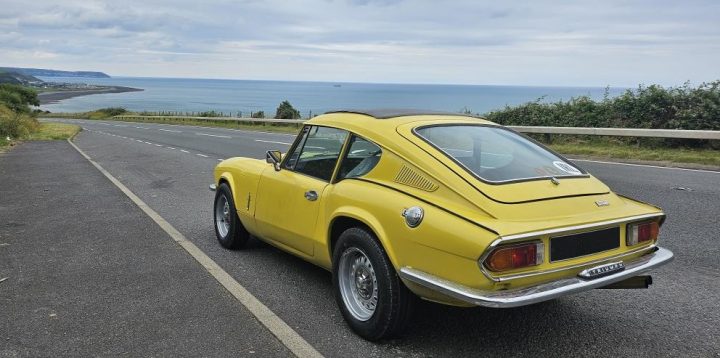
This one came in pieces from Ireland on the ferry. A yellow Triumph GT6 that its owner and a rotating cast of friends had been slowly working on for ten years. Much of the restoration work had been completed; the rolling chassis was done, the engine was done.
The body was done, or so we thought. What he needed from us was simple, on paper: fit it all together, sort out some remaining modifications to the Spitfire donor chassis so it would properly mesh with the GT6, and get it running. He wanted to drive it, not just own it.
We took the job on expecting exactly that. A big job, certainly – ten years of parts in boxes is never a quick reassembly – but not a complicated one. We thought it would be a case of building it all back up together.
It was only once we got the body up close that the job changed shape. What looked from a distance like a sound shell, turned out to be hiding rather a lot. There was filler tucked into the rear of the car – disguising considerable rot. Once we started digging into it, we found we needed a new rear valance, a new rear light panel, a new rear boot floor, and all the inner wings replaced.
The floor pans (already fitted) were reasonable, but nowhere near enough on their own. What had looked like a finishing job turned into 95 hours of structural welding – worked in around other jobs through the depths of that first winter – just to make the car safe.
That is the point in a restoration where the job stops being about steel and starts being about people. Ten years of his life had gone into that car, and so had the time of the friends who’d worked on it alongside him. It had become something closer to a shared community project. So when the true scope of the welding became clear, we didn’t just ring him with a number and leave him to it.
This is one of the things we’re proudest of at Cambrian Classics, and it’s one of the reasons we think we do this differently to a lot of other car garages: good communication all the way through a project.
We sent him photographs of the rust and rotten areas as we uncovered them, so he could see for himself what we were finding. There were several phone calls and conversations, not just one. We talked him through what a tidy GT6 was actually fetching in the current market, so he had a proper benchmark for whether this made financial sense at all, and we worked hard to put together a realistic budget for the project as it now stood.
That budget is genuinely difficult to pin down with this kind of work. You can’t always tell how many hours of welding a job like this will take until you’re properly into it – the more you strip out, the more you tend to find, and there’s a point in every restoration like this where you’re committed either way: keep going, or write the car off.
We were honest with him about that uncertainty too, rather than pretending we had a figure carved in stone. We kept updating him as we learned more, but obviously the ultimate decision had to be his own.
He chose to go ahead. Not because the numbers said so, but because the car wasn’t really about the numbers. It represented ten years of weekends, of friends turning up to help, of a dream for the running car. That was worth more to him than a straightforward financial return, and we understood that completely.
We managed to carry out almost all of the structural welding – the floor panels, the rear boot floor, the inner wings – without disturbing the existing paintwork, which was in good condition. In the end we only needed to paint the rear light panel and the rear valance.
There was a proper mechanical rebuild going on too. The flywheel had scored itself and needed skimming, and the spigot bearing inside the crank had worked loose, so the clutch came apart, was cleaned up, and went back together around new parts.
Both original carburettors were missing pieces internally and corroded beyond repair, so rather than chase parts for two dead carbs, we sourced a clean pair from a donor GT6 and tuned those in properly on the gas analyser once the engine was running. The brake servo had failed internally and went away to be reconditioned.
The car was rewired section by section, including a new loom for the overdrive, which had gone missing somewhere across its ten years in bits. The interior was all present and correct, so once the rebuilt rear half went back onto the chassis, it was a matter of working through the car front to back until everything ran as it should.
It’s back in Ireland now, on the road, being driven rather than stored in boxes. Ten years of patience, a lot of honest conversation along the way, and a decision made with the heart rather than a calculator – and a yellow GT6 that very nearly wasn’t finished is out on the road where it belongs.
ABOUT THE AUTHOR
Tim Winton is the founder of Cambrian Classics Ltd, a family-run business that specialises in classic car repair and servicing and is located by the beautiful Ceredigion coast. Cambrian Classics offers services that range from restoration and repair work to regular servicing and maintenance. Cambrian Classics is a recommended garage for both the MG Owner’s Club and Just Kampers, and regularly works on pre-1980’s classic cars, including pre-war vintage vehicles. Cambrian Classics specialises in a variety of classic marques including MG, Austin-Healey, Rolls Royce and Bentley, Alfa Romeo, Mercedes, BMW, Triumph, Volkswagen, Morris, Land Rover, Mini, Rover.
