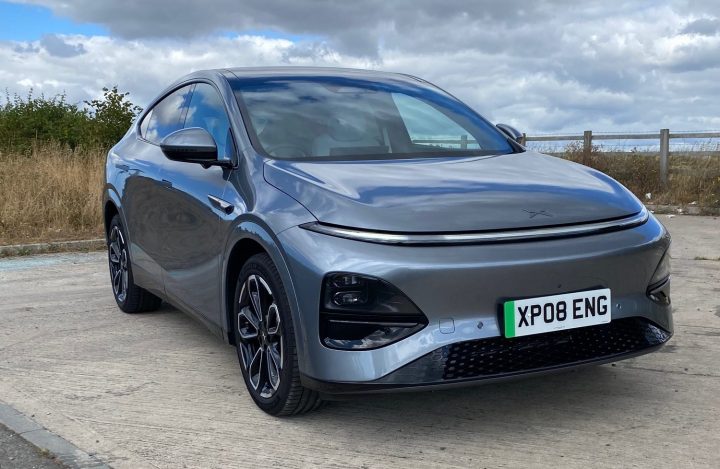
Whatever happens to the planed zero-emissions mandate with its stuttering schedule for implementation there is no denying it is bringing us some interesting and desirable models.
But few of the newcomers will have the ‘history’ of Xpeng, which like Tesla of America, was rooted in technology and software rather than motor cars. Not to be phased for the future of mobility, Xpeng is also designing a flying car complete with a carrier.
 It produced the G6 a couple of years ago but as rivals came out with their models, Xpeng decided it could do better and made about 20,000 changes to the latest models now on sale.
The standard and Long Range models went on sale in 2025 and Xpeng then brought Volkswagen into their engineering, design and production plans and created a Performance model with twin motors and all-wheel-drive. Their joint venture and engineering excellence created the range we have today.
The European and British models are assembled in Austria by a specialist contractor previously used by some of the major premium brands so the finished quality is very high. it also means that Xpeng gets around the EU tariffs being imposed on models made in China and exported to the Continent.
They are sold through an expanding network of UK retailers backed up by after-sales centres have a 5yrs/ 75,000 miles warranty on the car and 8yrs/ 100,000 miles on the battery pack.

The single-five door body style immediately strikes a viewer because it is a big car and with the powertrain layout and absence of a transmission tunnel it is a very roomy car for five with a huge boot and you can specify an optional front luggage tray if wanted (below).
 Big, deeply shaped, well padded seats throughout were not only comfortable but also securely held occupants and electric adjustment on the front pair together with a manual recline on the rear seats permitted a wide range of movement and would be ideal for long trips.
The driver is confronted with a wheel carrying some push and rolling switches which can perform different functions depending on the chosen menu in the Infotainment screen which dominates the dashboard including the door mirrors’ viewing angles. Behind the spokes are master switches for speed control, lights and wipers and another for direction of travel or parking.

Immediately in line of sight for the driver is the display for speed, electric charge and a few minor things as well as selectable images for things like tyre pressures. The big central display has far too many features to go into here but essentially is the brain for infotainment, communications, guidance, assistance systems, alerts and a driver can pre-select these for convenience and familiarity.
A full-length glass sunroof added to the spacious feel of the interior and despite the recent very hot weather it did not make the cabin unbearable and thanks to a very powerful air conditioning system it all chilled quickly along with four powered double-glazed windows.

Access to the cabin and boot was very good, room excellent, and ride comfortable even if you could hear how hard the suspension was working to smooth out the bumps and potholes.
Handling was good for a big car, although it’s not a sporting model in its Long Range form as opposed to the 4WD Performance, and it turned in a tight spot when parking but you need to rely on the multiple cameras for positioning.
At speed the steering was a little dead and lifeless on twisting roads but did not twitch or kick-back on main roads. We set the retardation to a strong effect and it meant the Xpeng G6 became a single-pedal drive and this was very useful in traffic.

This also helped get the most out of the battery and the G6 had a good useful range of 320 miles between quick charges. Acceleration response was also selectable and ranged from good to very quick with corresponding impact on range however.
Most significant is the fitting of a new 80.8kWh lithium-iron-phosphate battery which permits faster recharging and with a massive 400kW booster it will hit 80% in 12 minutes.
Top speed is close to 125mph and depending on model the 0-62mph time is approximately 7secs but the Performance slices this to under 4.2secs.
Noise levels were modest, confined to tyre and suspension rumbles most of the time with an occasional whining sound coming from a busy motor, without any other mechanical sounds, wind intrusion, squeaks or rattles.
It is inside that the Xpeng G6 really impresses with a very upmarket look to the seats and soft-feel surfaces and the large 15.6-inch multi-purpose infotainment screen, 10.25-inch driver’s dashboard screen and a 9-inch electric/ glass rear view mirror.
 Boot space rises from a nominal 570 to 1374litres but there is a lot of oddments space in the cabin for on-journey items. An optional front boot can be specified to extend capacity.
The technology at your fingertips is a computer geek’s delight with an enormous array of menus opening at a flick and prod and backed up by an AI graphic assistant who can carry out almost any command if the accent is understood and phrasing matches its algorithms and programming. We did catch it out a couple of times and had to resort to the manual swiped icons.
Performance was good in the rear-wheel-drive Long Range but the ride is unsettled and sometimes too firm for our liking.
As it sits now, the Xpeng G6 is a very worthy rival to other brands’ products and the upcoming Xpeng X9, will expand choice for families and businesses. If thinking of the BEV market, it’s worth remembering that any model over £50,000 carries a hefty road tax premium for five years after first year renewal even on the second hand market.
It could become the car of choice for many limousine and taxi services and it may be that this brand is exactly what they want for future mobility services particularly where zero-emission vehicles must be used.

