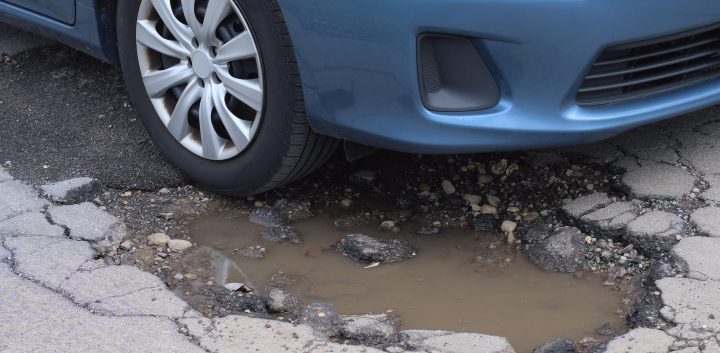
There is no quick fix for Welsh roads, reports ALARM survey
Road users should not expect a quick fix to the condition of local roads in Wales, despite reported increases in funding, says this year’s Annual Local Authority Road Maintenance (ALARM) survey report.
Significant investment in highways maintenance from both the Welsh Government, via the Local Government Borrowing Initiative (LGBI), plus local authorities’ own sources, has seen budgets increase by 35% on last year. However, this has only resulted in marginal improvements in road conditions to date and vital resurfacing takes place less frequently – now reportedly once every 132 years on average.
“I think all road users would agree that the condition of our local roads has become a national disgrace,” said David Giles, Chair of the Asphalt Industry Alliance (AIA), which commissions the ALARM survey.
“We can see from tracking ALARM data over the last decade that inconsistent funding levels, coupled with the impact of frequent adverse weather events on a consistently underfunded – and increasingly fragile network – means a well maintained network still lies a long way off.”
| How to win a pothole claim |
Highway maintenance budgets in Wales for 2025-26 are reported to have increased to an average £11.5 million per authority, with 51% of that spent on the surface and structure of the road.
Welsh authorities report that this has helped the percentage of the network classified as RED – likely to require maintenance over the next 12 months – fall by 2%. Nevertheless, 7% of Welsh roads – equivalent to over 1,400 miles – will still need intervention over the next year to keep roads serviceable and safe.
The ALARM survey reports local road funding and conditions in England and Wales based on information provided directly by those responsible for the maintenance of the network.
Findings of ALARM 2026, which relate to the 2025/26 financial year, also show that in Wales:
- Local authorities in Wales would have needed, on average, an extra £2.4 million each last year to maintain their network to their own target conditions and prevent further decline.
- The backlog of carriageway repairs in Wales is now £623.2 million. This is the amount that is reported to be required, as a one-off, for local authorities in Wales to bring the network up to their ideal conditions – £28.3 million per authority.
- Funding from central sources has increased from 26% of the total spent on highway maintenance (ALARM 2024/2025) to 45% this year. The additional investment forms part of the Welsh Government’s LGBI.
- More than 9,600 miles (48%) of local roads in Wales are now reported to have less than 15 years’ structural life remaining.
- 111,342 potholes were filled over the last year – up 12% on last year – at a cost of £8.8 million.
Commenting on the ALARM report, AA President Edmund King OBE, said: “The ALARM 2026 report starkly warns us how much more needs to be done to eradicate this plague of potholes. We have been seeing with our own eyes, and feeling with our wheels, how record wet weather linked to substandard roads has led to many local roads becoming patchwork obstacle courses.
“The AA has been called out to 4,680 pothole related incidents in Wales in January and February this year. Extra funding needs to be maintained and spent on more permanent repairs to prevent extensive vehicle damage and potentially fatal injuries to those on two wheels.”
AIA Chair David Giles added, “Welsh authorities report that they are cautiously optimistic that the increased funding available over this year and next should help them stem further decline.
“However, with an in-year shortfall of over £52 million, it’s not the silver bullet that will enable them to clear the backlog of repairs any time soon and the public is unlikely to see lasting improvements unless the additional investment is sustained over a longer period.
“And, sadly we’ve been here before in Wales as improvements in conditions achieved in the early 2010s were soon lost as incremental funding proved short-lived.[1]”*
The full ALARM survey report will be available to download from 00.01 hours on Tuesday 17 March 2026 at: www.asphaltuk.org
RAC Head of Policy, Simon Williams, said, “As drivers testify, decades of underinvestment have left many roads in a woeful state of disrepair – something that’s been even more noticeable since the beginning of the year with our teams receiving hundreds of breakdown reports every day mentioning potholes.
“We hope new record levels of funding from central Government and a commitment to longer term investment that allow councils to plan highways maintenance will mean we start to turn a corner – although it will be some time before drivers notice a real difference.
“The path to better roads isn’t complicated: ensure water always drains off the roads, fix potholes as permanently as possible, seal roads against water ingress through preventative maintenance, and resurface those that have gone beyond the point of no return.”
Motorcycle Action Group (MAG) Director of Campaigns and Political Engagement, Colin Brown, went on, “Local authorities are telling us something important: if the repair backlog was cleared, it would actually cost £1 billion less per year to maintain the network properly.
“That’s the case for frontloading investment in a single sentence. For MAG, though, the argument goes well beyond balance sheets. Government data consistently shows that road surface conditions contribute to twice the proportion of motorcycle killed or seriously injured (KSI) casualties compared to both car occupants and cyclists – 4% versus 2%, every single year for a decade.
“Riders aren’t complaining about cracked roads because of the damage to their tyres – it’s the added risk of dying on them. The Government needs to frontload this funding.”
Local Government Association Chair of the Inclusive Growth Committee, Cllr Tom Hunt, added, “More funding being directed towards fixing roads, alongside some longer-term certainty is positive. However, the fact that councils still face an £18.62 billion backlog of local road repairs, shows more action is needed for councils to bring roads up to scratch.
“Local authorities work hard to fix potholes swiftly to prevent people’s journey from being impeded. The scale of the backlog and the many factors that affect repair rates, from the type of road and traffic levels, to changing weather patterns, means local government is having to do more with less, and find innovative new ways to respond to the issue.”
IAM RoadSmart Director of Policy and Standards, Nicholas Lyes, concluded, “The embarrassing state of our local road network is fast becoming a national scandal. Around one in six local roads are effectively on life support with less than five years of structural integrity remaining.
“What was once deemed an irritant with expensive consequences, poorly maintained local roads now represent a real road safety hazard. Our research suggests drivers are taking risky actions to avoid hitting potholes, while for those on two wheels, they can cause serious injury or worse.
“We need a long-term approach that invests in proper surface maintenance, rather than the all too often ‘patch and dash’ repairs that crumble at the first sign of bad weather.”
