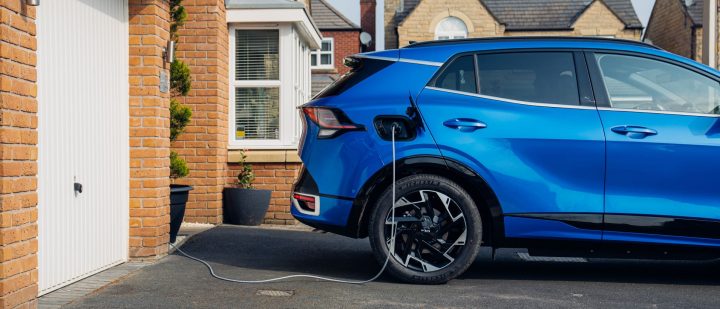
For a long time, home EV charging has been framed as something reserved for homeowners with driveways and detached houses.
If you rented your home or owned a flat, the assumption was that low-cost charging at home simply was not an option.
Given that the cost of public charging can be up to 10 x the cost of the lowest domestic charging-specific tariffs, it is little wonder EVs attained a bad rep for flat owners and renters.
 Now, Sally Bailey, Head of EVC Sales at Vestel Mobility- UK (above), says the government’s EV charger grant for renters and flat owners will finally democratise EV ownership.
The government-backed scheme called the EV Chargepoint Grant is quietly removing one of the biggest barriers to electric vehicle ownership for renters and flat owners.
It offers up to £350 off the cost of installing a home EV charger and, crucially, the application process is handled almost entirely by the installer. For most people, that means no forms, no chasing approvals, and no complicated admin to wrestle with in the evenings.
If you live in rented accommodation or own a flat and have access to an off-street parking space, whether that is a driveway, a designated bay, or a private car park space, you may well be eligible.
The key requirement is that you have the legal right to use that space and that you are the main user of the electric vehicle. The charger does not need to be installed directly on the building itself, and the vehicle does not even need to have arrived yet. Many people arrange installation while their new or nearly new car is still on order.
“One of the biggest misconceptions I encounter is that landlord approval makes the process slow or difficult. In practice, many landlords are far more open to EV charging than people expect, particularly when the installation is neat, professionally installed, and largely funded through a government grant. Installers are used to dealing with these situations and can often advise on permissions and cable routing in a way that keeps disruption to a minimum.
“Ironically, it looks even more appealing to your landlord to approve an installation if you are a relatively short-term renter. Properties with an EV charger have greater appeal to buyers or renters and increase value according to a host of surveys by the likes of Zoopla, Vauxhall and Riverdale leasing.”
Across the UK rental landscape specifically, EV charging is quietly shifting from novelty to negotiating chip. Direct Line’s survey of over 1,000 residential landlords revealed that two in five would install a charge point specifically to lift the capital value of their property. The same proportion viewed an installed EV charger as a magnet for more discerning tenants, and a further 15% openly recognising its potential to justify higher rents to new tenants.
Lower running costs
Where home charging really starts to make sense is when people look at the day-to-day running costs. Electric vehicles and plug-in hybrids are not just about cleaner transport, although that is an important part of the story. They also happen to be dramatically cheaper to fuel than petrol or diesel cars, especially if you can charge overnight at home. The higher your annual mileage the larger that benefit will be.
Many energy suppliers now offer off-peak electricity tariffs designed specifically with EV charging in mind. Some of these drop as low as around 7.5p per kilowatt hour during overnight hours. To put that into real-world terms, a typical electric car might use roughly 3 to 4 miles of range per kilowatt hour.
Even at the conservative end of that scale, a 200-mile round trip could use around 60 kilowatt hours of electricity. At 7.5p per kilowatt hour, that works out at just £4.50 for the entire journey. Even with the government proposed 3p per mile EV levy from 2028, that would only add £6 to the journey cost – still way, way cheaper that petrol.
For comparison, covering the same distance in an ICE car returning 45 miles per gallon could easily cost £35 or more at today’s fuel prices. That difference is not a sales pitch; it is simply arithmetic.
For drivers who do regular commuting or frequent longer trips, the savings on running an EV quickly add up, particularly if you also factor in lower cost road-tax, lower servicing costs, and other government incentives.
Of course, it is important to say that switching to an electric vehicle should not be about chasing the cheapest possible running costs at all costs. From an environmental point of view, the most sustainable car is often the one already on your driveway. Although moving your vehicle on, simply means the subsequent owner of your old vehicle will be running it and so on, so it’s arguably a moot point.
Electric vehicles make most sense when you are already in the market for a new or nearly new car, whether that is because your current vehicle is reaching the end of its life or because your circumstances are changing. The shift to electric vehicles is about reducing our reliance on fossil fuels and cutting emissions over time.
Home charging simply makes that transition easier and more practical for a far wider group of people than was previously possible, and the EV Chargepoint Grant simplifies it further.
Grant easy
“What I find most encouraging is how accessible the process of applying for these grants has become. The installer applies for the grant on the customer’s behalf, submits the evidence, and claims the funding directly.
“The customer simply sees a lower price on their invoice. There is no need to navigate government portals or decipher eligibility rules on your own. For renters and flat owners who assumed they were excluded from the home charging conversation, this simplicity can come as a genuine surprise.”
As electric vehicles become more common on UK roads, it is essential that charging infrastructure keeps pace in a way that works for real people in real homes, not just idealised scenarios. Grants like this help level the playing field and ensure that cleaner transport is not limited by housing type or tenure.
She added “I see the EV ChargePoint Grant for flat owners and renters and a pivotal step in the evolution of personal transport in the UK towards electric as it’s a win-win-win for all the tenant or flat owner, the landlord or freeholder, and the environment.”
