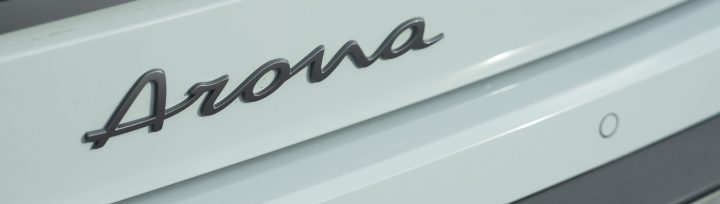
SEAT knew what they were doing when launching the original Arona compact crossover in 2017 and it has become one of the brand’s best sellers after revisions in 2021 and 2025.
Using platforms and powertrains from within the Volkswagen Group it reduced costs but not quality when pitching into the all-important family sector.
 Being not too big under 4.2 m long and taking up to 828 litres of luggage with small and mid-sized engines, it offers real challenges to competitor models, ironically including parent VW models which use the same technology.
Arona has been constantly revised and improved and now comprises four trim levels, SE, SE Technology, FR First Edition and our test car’s FR Sport. The top duo have front and rear parking sensors, rear camera, black badging and twin exhaust pipes.
More significantly, we suggest, it also has 10-inch digital cockpit display, exclusive cloth covered bucket style front seats and four driving modes for the purists. Wheel sizes are selectable as well and we had standard 215/245SR18 tyres.
 Prices rise from about £23,105 to £30,540 depending on permutations above, so it pays to carefully consider that you want, need and most importantly, what you can afford. Used prices reflect about a 43 to 46% drop from new over 36,000 miles and three years.
The FR Sport petrol engine acquitted itself very well with instant starting, strong mid range pulling power ideal for a full family load, relaxed long-legged and economical performance, particularly on motorways.
 Fuel economy was always in the high 40s and with some distances on motorways it was heading into the mid-50s without any effort by the driver to be conservative.
We thought that was good for the smooth automatic DSG transmission and its highly desirable in urban use.
Ok, it’s not the briskest SUV but what is the purpose of a modern urban SUV, but to take families out, ferry children to sports events or friends, and then maybe occasionally drop large items to the local recycling dump?
 It fulfils all these tasks very easily with good access to the cabin, a low long and wide bootspace which easily stretches when the rear backrests are folded almost flat and it was comfortable doing all off the above.
The seats were well shaped and supporting, the front pair had a lot of adjustment room and combined with the reach and rake of the steering column a good driving position.
All controls were immediately to hands and fingers, it braked quickly and safely but I would have liked an auto-hold when parking rather than traditional handbrake which needed strong application to safely work.
Our test car’s automatic transmission also seemed jerky when moving off or reversing and this could be unsettling when slowly manoeuvring or parking.
 It steered well with a reasonably tight turning circle and good feedback on faster roads, a safe and surefooted character on country lanes and no twitchiness.
The ability to choose three driving modes and additional multi-individual settings was good, but why the system always defaulted to normal was irritating and unnecessary.
 The Arona’s secondary controls were well placed and worked faultlessly while the instruments’ display was simple, clear and variable depending on chosen mode. The infotainment screen in the centre of the dash was large and clear but its features were best operated by the passenger as they involved some distraction from the road ahead.
Heating and ventilation was highly effective at warming the interior, cooling in the sun, and showed good directional control and output with the benefit of powered windows all round.
In a family car you need a lot of oddments space and the Arona didn’t disappoint in this respect even if some of the compartments were individually on the smaller side.

Any SUV has to be a compromise so far as suspension is concerned, comfortable for a full load of people and then not too soft when driving alone and the Arona tended towards firmness if less than three people were aboard.
The suspension’s rumble showed how well it soaked up the worst bumps but sometimes the system struggled and it was uncomfortable.
 The noise in the cabin was possibly intensified by the lack of soft finishes and reliance on hard plastic trim that should last the vehicle’s lifetime anyway.
SEAT has done a really good job of updating, refreshing and improving the Arona after almost a decade and it can still hold its own against newer and less capable challengers.

