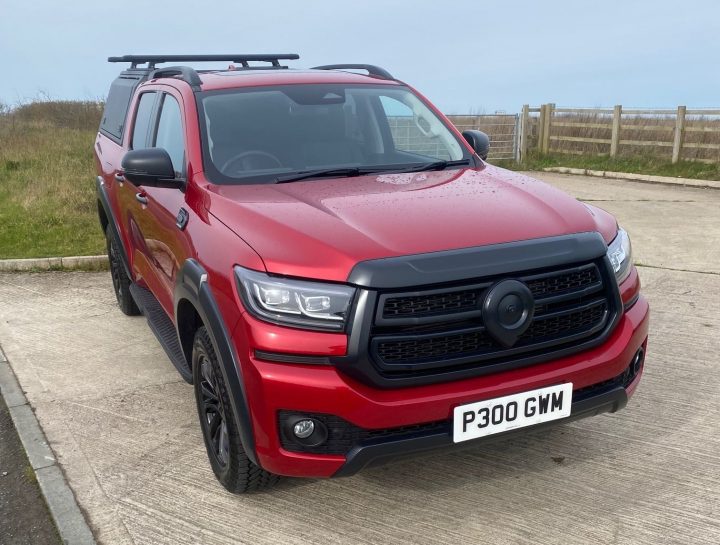
Once upon a time pick-ups were the workhorses of the countryside and contractors.
Then it changed and they became the way to save on a tax return without suffering too much in refinement.
 Advance a couple of years and the market reverted to tax changes which really favoured the basic pickup and many models became much more expensive and a tax liability unless you really needed a workhorse rather than a dressage double-cab.
It meant the market for working pickups changed and the range was comparatively small so creating the opportunity for new entrants.
The Midlands-based IM Group saw this as time to bolster its presence alongside their Isuzu PU and last year launched the Chinese Great Wall Motors’ Poer300 Double Cab series in Lux, Ultra and Vanta trim levels.
Unlike some European and American brands which still looked to extract more money from high specification pickups, GWM cut to the core with the Poer300.
 It comes with a basic big diesel engine matched to a nine-speed automatic transmission, selectable rear or four wheel drive with low range and eco, normal or sport modes.
Adding to its specification was a suite of advanced driver aids and safety features usually found in European cars as well as luxury treats like trim-specific heated/ cooling seats and warming steering wheel, sunroof and air conditioning. They were all delivered from a little over £30K rising to £37K plus VAT.
 The Vanta we tested had the black trim finish to detailing around the wheels, mirrors etc., but its equipment level compared to the mid-range Ultra, so you can choose to pay for the more eye-catching appeal, or not, as you wish.
It’s 2.4 litre engine packs a punch for pulling a big trailer or carrying a heavy load and with nine gears available it proved very smooth changing irrespective of load. Bald figures alone don’t tell the true story and while its time to 62mph is modest, there is a strong feeling of power being delivered and available.
Normally it runs in rear wheel drive but stop and select 4WD, engaging diff lock and you have a really capable off roader so long as any water obstacle is no deeper than 50 centimetres, or close to 20-inches.
The engine’s four-cylinders make their presence heard as more throttle is applied and despite being a little slow off the mark, the revs quickly rise as with most turbo-diesels, giving it a gutsy pull mid-range which is ideal for pulling trailers or a loadbed full of materials.
 Our hardtop came with side opening and lockable panels to ease access or ventilation if carrying animals and it was completely isolated from the double cab which had room for three in the back with reasonable legroom.
 The powered front seat moved through a good range of settings and both leg and headroom was good in them, while their shape and padding was supporting and comfortable and helped absorb the on-road bumps which the suspension struggled to do.
The loadbed capacity is good, spreading over the width of the vehicle and was long, but not very high. Access was aided by a fold away step – why has no-one else done this?
Inside the cab, oddments room was really good with big bins and recesses, a decent glovebox and a few pockets.
 The main controls were all easy to use despite the odd shape of the gear selector but I found it was sometimes difficult to locate the cruise control stalk hidden low down on the left of the column while the wheelspokes also blocked direct views of the lights and wiper stalks.
On the last point, there is no rear wiper fitted for obvious reasons of the double-cab and rear loadbed cover and the back windows did get dirty and were impossible to clean on the move.
The cab also tended to mist up a lot and the system struggled to clear it for some time.
The Vanta’s reversing camera gave a really good view and overcame the shortcomings of the misted back windows.
Headlights were bright on main beam, much weaker on dip setting, and had a good spread of illumination. The front washer system was up to its job.
 You climb up into the cab and have a good view to front and sides, but over the shoulder and when reversing requires a lot of caution and checking.
The driver’s panel carried the essential information and displayed it well with sharp characters and good lighting but we found it very slow to change and show particular data.
 The larger infotainment screen in the dash centre was very clear and once you learned to plough through the menus it was good although sometimes we wished it gave more time to reselect a feature.
The Vanta’s kerbweight over two-tonnes contributed to its modest performance from the hard-worked four-cylinder turbo-diesel engine but used within its acceptable noise limits it was a solid performer with really smooth gearchange.
The brakes also did a good job hauling down speed and the autohold facility worked well on slopes and in traffic.
 It was more of a struggle to come to term with the very wide turning circle, which would be good in a field but not so useful negotiating tight tree-lined tracks or when parking in streets or a car park as the footprint of the Vanta meant it overhung all the marked spaces we regularly use.
On cross country main road roads the Poer300 did not generally like to be hurried, with slow in and gentle acceleration through a corner being ideal. Approach too quickly, dab brakes and it would want to run wide, even possibly nudge itself towards becoming tail-happy if you lifted off.
 The steering did not like a rapid change of direction while it also kept pulling the Poer300 away from central lines or road-edge markings through the ADAS system.
The suspension seemed set up for crossing fields and rough tracks and when it encountered metalled surface potholes it just jarred the chassis as if surprised. Even some speed bumps produced a severe jolt at 20mph.
So, in conclusion, the GWM Poer300 is a workhorse which has the ability to do a good job, a serious job, but it’s not in the same league as some longer established rivals which are more expensive and refined. But it has to be asked would you want these challengers to do what the Poer300 does well where it matters?

