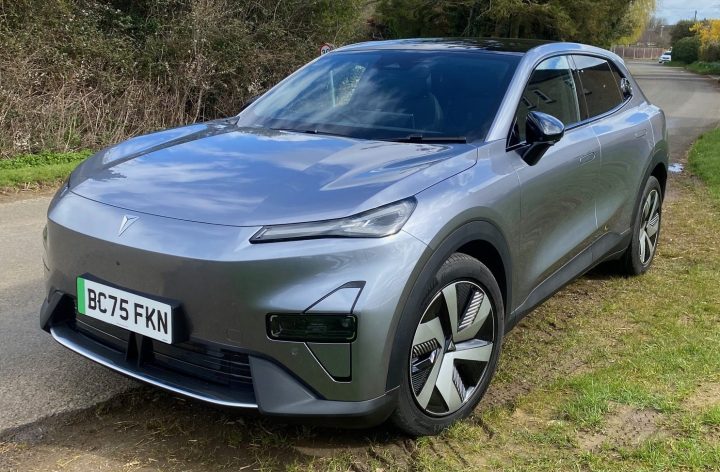
China’s latest entrant into Britain’s car market is also one of its oldest domestic car makers, Changan, whose name translates as “lasting safety”.
After beginning as a munitions manufacturer in 1862 and then military vehicles in 1959, it eased into cars 25 years later and has worked with Suzuki, Mazda and Ford to develop models for its home market. By 2006 it was making its own models and from 2017 began concentrating on new energy vehicles with electric powertrains with a lot of technology incorporated as well.

Its badge is a three-pointed star which identifies with its first domestic models in 1984 but it’s living up to its name and the Deepal SO5 specification includes a standard dashcam and 7yrs/ 100K mechanical warranty alongside an 8yrs/ 124K battery cover.
This is just some of the surprising technology among a true library of standard features you’ll be offered and no doubt take time to appreciate and even, maybe, use.
Changan entered the UK market in 2025 with the bigger SO7 model and now this has been joined by the SO5 pure electric SUV in rear or all-wheel-drive, but more models including a plug-in hybrid petrol version are coming. One of the really significant models will be a smaller electric car, the Nevo, coming in about a year.
There is also the Avatr premium series and Kaicene van, which could be food for thought and concern among the CV manufacturers.
 As if they are not enough, the company’s portfolio also runs to city cars and an electric-petrol 4×4, but we don’t yet know which models Changan UK will concentrate on. It is, nevertheless, tantalising to think what might be coming and when.
They will be no surprise to the Changan UK 100 engineers based in Birmingham who are developing the new powertrains after a £22 Million investment in British R&D, or the Turin external styling centre home to 300 specialists, the Yokohama, Japan interior styling studio and Detroit autonomous driving facility. They have 24,000 people on payrolls.
 Changan sold 2.9 Million vehicles in 2025, including a million EVs through 14,000 dealers worldwide including flour in Wales and aiming for 60 this year in Britain, and says Europe is their most important region, so the SO7 and SO5 were developed especially for these tastes in Turin and Birmingham.
The duo of Deepal SO5 come in identical trim and the 268bhp 112mph RWD version is good for a 0-62mph time of 7.5 seconds with a range of approx 300 miles while the AWD 429bhp version hits 62mph in 5.5 seconds but the range is slightly shorter while maximum speed is about the same. The 68kWh CATL battery can be charged at up to 200kW and from 0-80% in just 15 minutes, a very fast performance.
The RWD costs £37,990 and the AWD is £2,000 more.

First impressions
Our first drive in the Deepal SO5 RWD impressed with its room, both for five people and a 492 litres boot extending to over 1200 litres, and the really comfortable seating, which includes a fully reclining front passenger feature which they call the Queenie or Rest mode.
Different driving settings immediately altered the car’s character, responses and range potential through a central swivelling screen and a driver can tailor the head up display from showing a simple speed readout to much more packed information such as directions, power use etc..
It takes a little getting use to but it’s as simple or detailed as you want with data split between the HUD and the big infotainment screen.
Acceleration in sport mode was very brisk, steering was fairly precise and had a tight turning ability, feelsome brakes and suspension soaked up poor roads but we thought it was a bit too stiff in damping the recovery so it could be unpleasant coping with a lot of potholes.
With cameras all round, big windows and strong wash/ wipe, visibility was good.
Apart from the road rumbles and bumps there was little noise generated thanks to the aerodynamic shape and powertrain.
The sheer level of equipment and tech in the Changan Deepal SO5 impresses at these prices and must seriously worry traditional legend brands, particularly as there are no serious flaws, and it stacks up well against the new generation of Chinese challengers.

