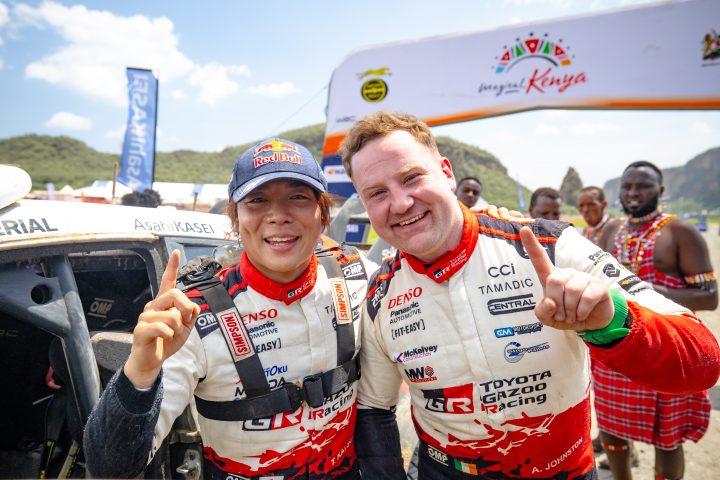
Takamato Katsuta and co-drover Aaron Johnston achieved their first FIA World Rally Championship (WRC) victory yesterday at the Safari Rally Kenya, continuing Toyota Gazoo Racing World Rally Team’s (TGR-WRT) unbeaten run on the epic event.
Katsuta becomes only the second Japanese driver to win a WRC round after Kenjiro Shinozuka’s victories in the early 1990s. He is also the second Japanese driver to win the Safari following Yoshio Fujimoto’s triumph with Toyota in 1995 when the event was held as a round of the 2-Litre World Rally Cup.
While the Safari has a reputation as one of the world’s most demanding rallies, Katsuta has always performed strongly there, having scored three podiums from five previous starts including his maiden WRC rostrum visit in 2021. Last year the event also delivered late heartbreak when his attempts to snatch another podium finish ended in retirement.
He again entered this year’s edition fresh from fighting for a victory and finishing second at last month’s Rally Sweden and made a solid start to the weekend only to lose time on Friday afternoon with a double puncture, leaving him seventh overall and almost two minutes off the lead.

He didn’t give up though, and focused on staying out of trouble on what was expected to be an extremely demanding Saturday. Sure enough, as other drivers including his rally-leading team-mates hit difficulties on the muddy and rocky stages, Katsuta climbed the order and found himself taking the lead arriving into mid-day service.
He increased his lead to 1 minute 25.5 seconds over Adrien Fourmaux (Hyundai) going into Sunday’s final day and then carefully managed his advantage through the final four stages to secure victory by 27.4s.
Katsuta’s win completes a road to the top step of the WRC podium that began when the former circuit racer joined the Toyota Gazoo Racing WRC Challenge Program in 2015 with minimal prior rally experience.
His win is the sixth Safari triumph in as many attempts for TGR-WRT since the event returned to the world stage in 2021, and a record-extending 14th victory for Toyota.
The team’s five GR YarisRally1 cars filled out the top five places in the early part of the rally but heavy rain in the build-up and during the rally week made this the most demanding Safari Rally of the modern era and punished all the Rally1 cars – with only four completing every stage without significant technical issues.
The thick mud of the third stage on Saturday morning proved especially punishing for TGR-WRT’s top three cars at the time, with Elfyn Evans forced to retire with suspension damage and both Oliver Solberg and Sébastien Ogier stopping after mud contaminated the alternators on their cars.
Sami Pajari also lost around five minutes with significant tyre damage in Saturday’s second stage but went on to score his fifth stage win of the rally that afternoon and climb back up to third – ultimately securing his second successive podium and third in five events with co-driver Marko Salminen.
Solberg, Ogier and Evans all restarted on the final day to chase Super Sunday and Power Stage points. They each took a stage win across the day’s first three tests before Solberg and co-driver Elliott Edmondson prevailed in the Power Stage to top both classifications and secure the maximum 10 bonus points. Ogier and Vincent Landais were second in the Power Stage and Super Sunday, and Evans and Scott Martin third.
Evans continues to lead the drivers’ championship, eight points ahead of Solberg and 11 in front of Katsuta. Maximum Sunday points keep the team at the top of the manufacturers’ standings by 43 points.
Two GR Yaris Rally2 cars also finished in the overall top 10, with Gus Greensmith finishing sixth outright and second in WRC2 on his debut in the car and Diego Domínguez taking ninth overall and fifth in class.
